In this article
The India-Pakistan cricket rivalry stands as one of the world’s most intense sporting contests, marked by high viewership, fervent fanbases, and unforgettable moments. Rooted in a complex shared history, each match between these teams transcends sports, symbolizing national pride and stirring excitement worldwide. This rivalry, which began in 1952, has evolved into a spectacle, especially during ICC tournaments, where stakes and tensions run high.
This article traces the complete timeline of the rivalry, highlighting legendary matches, pivotal moments, and the lasting impact these games have on players and fans alike.
Historical Background: How the Rivalry Began
The origins of the India-Pakistan cricket rivalry can be traced back to 1947, when the British Indian subcontinent was divided into two independent nations: India and Pakistan. This Partition created a distinct, and often tense, dynamic between the neighboring countries, setting the stage for competition beyond just politics and diplomacy. Cricket, a sport both nations had embraced during British rule, became a prominent area of rivalry, providing a platform for both countries to assert their national pride and sporting prowess.
The first official Test series between India and Pakistan took place in 1952, only five years after Partition. Pakistan, having recently been granted Test status by the International Cricket Council (ICC), embarked on a tour of India. This series, while competitive, was marked by mutual respect as well as moments of high tension, foreshadowing the intense encounters that would follow in the decades to come. India won the opening Test match in Delhi, but Pakistan’s impressive win in the second Test in Lucknow set the tone for what would become one of the world’s most storied sporting rivalries.
Political tensions often played a role in the scheduling and frequency of matches between the two teams, especially with bilateral cricket ties being suspended multiple times over the years. The Indo-Pakistani wars of 1965 and 1971 halted cricket matches for over a decade, resuming only in 1978. These interruptions, though frequent, heightened the anticipation and intensity of each encounter, as fans waited eagerly to witness their teams compete on the field.
Today, the India-Pakistan cricket rivalry is as much about history and pride as it is about the game itself. This unique backdrop has helped shape the rivalry into one that holds special significance for players and fans alike, with each match embodying decades of history and passion.
Also Read Why Ruturaj Gaikwad and Ishan Kishan Missed Out on India’s T20I Squad vs Bangladesh?
India-Pak rivalry
Key Phases of the Rivalry (Chronological Timeline)
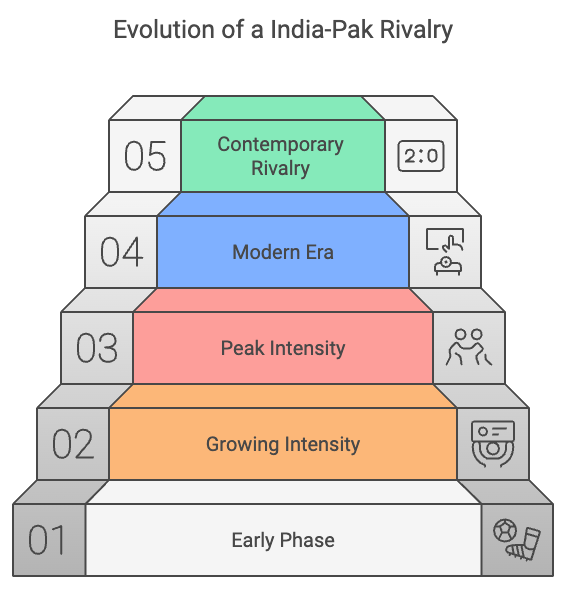
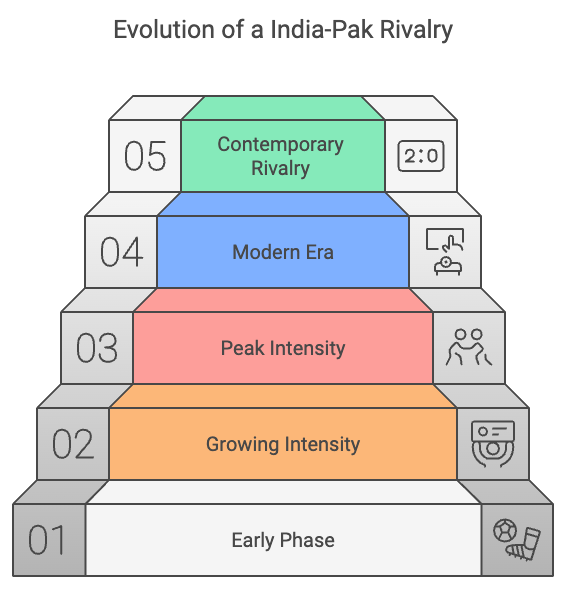
1950s-60s: The Early Phase
The rivalry began in the 1952–53 series in India, which saw five Test matches played. India emerged victorious with two wins, while Pakistan claimed their first-ever Test win in Lucknow, making it a historic moment. The following series in 1954–55 saw Pakistan host their first Test series, resulting in a drawn five-match series where neither side could secure a win. This era set the foundation for a competitive yet cautious rivalry, with defensive playing styles and drawn matches common in the initial years.
- Key Matches: India’s first-ever Test victory over Pakistan in Delhi, and Pakistan’s first win in Lucknow.
- Series Summary: India won the 1952-53 series, while subsequent series were drawn.
1970s-80s: Growing Intensity
After a 17-year break due to political tensions, the rivalry resumed in 1978–79 when Pakistan hosted a three-Test series, which they won decisively, marking the beginning of a more intense competitive phase. The introduction of One Day Internationals (ODIs) in 1978 added a new dimension, with Pakistan winning the initial series at home. Matches during this period often saw heated on-field moments, with players like Sunil Gavaskar and Imran Khan emerging as prominent figures in the rivalry.
- Test Series Highlights: Pakistan’s first Test series win in 1978–79.
- ODI Beginnings: Pakistan dominated the early ODIs, winning the inaugural series 2-1.
1990s: The Peak of Intensity and Iconic World Cup Clashes
The 1990s were marked by highly competitive matches, particularly in World Cup tournaments, making this decade one of the most memorable for fans. Pakistan had an edge in ODIs, winning 26 out of 46 matches, while India shined in ICC tournaments, notably in the 1996 World Cup quarter-final. Political tensions again influenced matches, and series were often played on neutral grounds like Canada, intensifying fan involvement globally.
- Key ODI Series: Pakistan won multiple ODI series, including matches in Canada, solidifying their lead in this format.
- Iconic Match: India’s victory in the 1996 World Cup quarter-final, a highly anticipated and intense encounter.
2000s-2010s: Modern Era of Rivalry and Global Stage Encounters
The rivalry continued into the 2000s with high-profile encounters in ICC events, including the 2003 World Cup and the 2007 T20 World Cup final, where India triumphed in a nail-biting finish. Bilateral series were revived in the early 2000s, with memorable performances from young talents like MS Dhoni and Virat Kohli for India, and Shahid Afridi for Pakistan. The rivalry drew massive global audiences, and fan engagement soared with social media’s rise.
- Memorable Series: India’s win in the 2003–04 Test series in Pakistan and 2007 T20 World Cup final victory.
- Fan Influence: Record-breaking viewership, particularly during ICC tournaments.
2020s and Beyond: The Contemporary Rivalry
The 2020s have seen a resurgence in ODI encounters, with both teams performing at a high level. Matches such as the recent 2023 World Cup game in India, where India won decisively, illustrate the continued fervor and anticipation surrounding these encounters. Young stars, political tensions, and strategic shifts continue to shape the future of this storied rivalry.
- Notable Matches: India’s win over Pakistan in the 2023 ODI World Cup.
- Future Outlook: With ICC tournaments scheduled, the anticipation for the next India-Pakistan encounters remains high.
Also Read How Virat Kohli Surpassed the Master Blaster, Sachin Tendulkar.
Indian Pakistan Cricket Rivalry
Iconic Matches and Moments
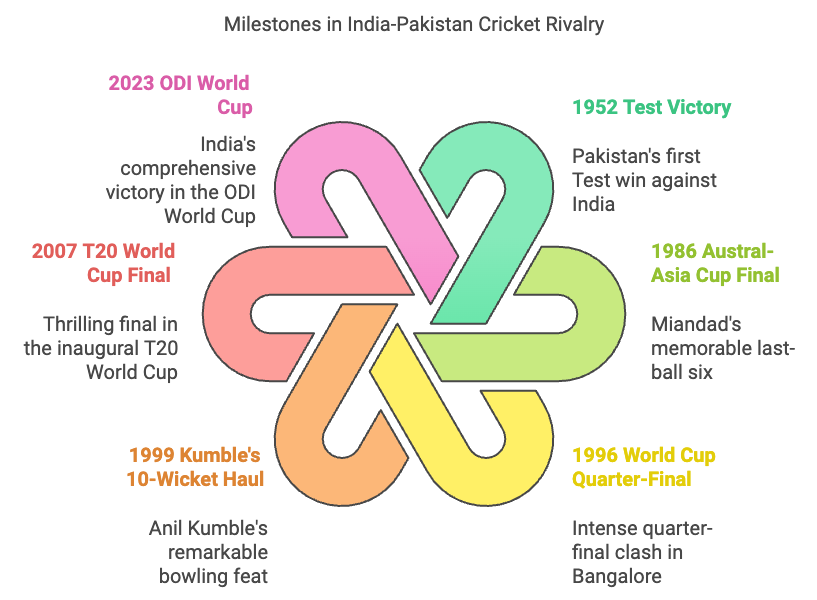
The India-Pakistan rivalry has been marked by unforgettable matches and dramatic moments that have defined cricketing history. From last-ball thrillers to record-breaking performances, here are some of the most iconic games in the rivalry.
1. 1952 – Pakistan’s First Test Victory in Lucknow
- Date: October 23, 1952
- Venue: Lucknow, India
- Overview: Just a year after earning Test status, Pakistan faced India in a historic five-Test series. After losing the first match, Pakistan bounced back with a commanding win in the second Test in Lucknow, securing their first-ever Test victory.
- Key Performances: Fazal Mahmood’s devastating bowling led Pakistan to victory as he took 12 wickets, ensuring a landmark win for Pakistan.
- Impact: This victory cemented Pakistan’s place on the international stage and intensified the emerging rivalry, setting the tone for competitive cricket between the two nations.
2. 1986 – Austral-Asia Cup Final, Miandad’s Last-Ball Six
- Date: April 18, 1986
- Venue: Sharjah, UAE
- Overview: With Pakistan needing a four off the last ball to win, Javed Miandad faced Chetan Sharma in one of the most thrilling finishes in cricket history. Miandad hit a six on the final ball, sealing a dramatic victory for Pakistan.
- Key Performances: Miandad’s unbeaten 116 remains one of the most famous innings in ODI history, showcasing resilience and calm under pressure.
- Impact: This iconic six is still celebrated in Pakistan and is remembered as a turning point that added extra intensity to the rivalry, with future matches often echoing the suspense and drama of this finish.
3. 1996 – World Cup Quarter-Final Clash in Bangalore
- Date: March 9, 1996
- Venue: Bangalore, India
- Overview: India and Pakistan faced off in a high-stakes World Cup quarter-final that captured the attention of millions. In front of a packed stadium, India posted a strong total, and Pakistan’s chase, led by Aamer Sohail, seemed promising until India’s bowlers took crucial wickets.
- Key Performances: Navjot Sidhu’s 93 and Venkatesh Prasad’s pivotal dismissal of Aamer Sohail were match-defining moments.
- Impact: India’s victory in this emotionally charged match made it one of the most memorable World Cup games in the rivalry’s history, with fans on both sides witnessing a display of intense competition and national pride.
4. 1999 – Anil Kumble’s 10-Wicket Haul in Delhi
- Date: February 7, 1999
- Venue: Delhi, India
- Overview: In the second Test of Pakistan’s tour of India, Anil Kumble achieved the rare feat of taking all 10 wickets in an innings, becoming only the second bowler in Test history to do so.
- Key Performances: Kumble’s 10 for 74 stands as one of the greatest bowling performances, particularly against a strong Pakistan lineup.
- Impact: This match remains iconic not only for Kumble’s achievement but also for its symbolism, as a masterclass performance in a high-stakes game between arch-rivals.
5. 2007 – T20 World Cup Final
- Date: September 24, 2007
- Venue: Johannesburg, South Africa
- Overview: The inaugural T20 World Cup final between India and Pakistan was a historic clash. In a thrilling match, India emerged victorious in the final over, with Pakistan falling just five runs short of the target.
- Key Performances: Irfan Pathan’s three-wicket spell and Misbah-ul-Haq’s valiant 43 almost took Pakistan to victory, but an attempted scoop shot off Joginder Sharma’s bowling led to his dismissal and India’s win.
- Impact: This match kickstarted T20 cricket’s popularity and reinforced the India-Pakistan rivalry’s global appeal. India’s victory in this dramatic final is celebrated as one of their greatest achievements in T20 cricket.
6. 2023 – India’s Comprehensive Win in the ODI World Cup
- Date: October 14, 2023
- Venue: Ahmedabad, India
- Overview: In the most recent ODI World Cup encounter, India hosted Pakistan in front of a record-breaking crowd at the Narendra Modi Stadium. India showcased a dominant performance, winning comfortably and furthering their unbeaten World Cup record against Pakistan.
- Key Performances: India’s bowlers restricted Pakistan’s total before Rohit Sharma’s aggressive half-century led India to a comprehensive victory.
- Impact: This match underscored India’s recent dominance in ICC tournaments, continuing a World Cup trend that has heavily favored India. It highlighted India’s prowess and the fervent fan support in modern India-Pakistan encounters.
Impact on Tournaments and World Cups
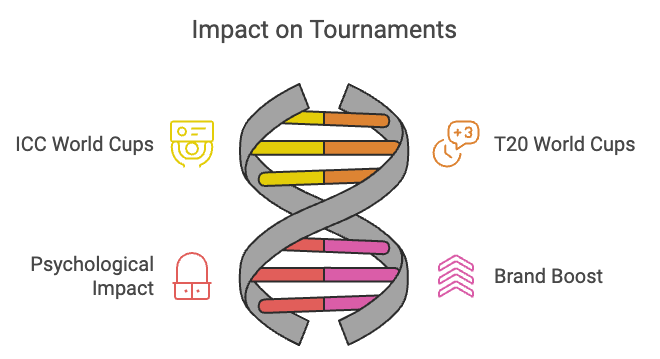
The India-Pakistan cricket rivalry has consistently elevated the stakes at ICC tournaments, transforming ordinary matches into blockbuster events. Since their first World Cup clash in 1992, India and Pakistan have faced each other multiple times in various ICC tournaments, with these matches often attracting record-breaking viewership and intense fan engagement worldwide.
1. ICC World Cups
- Overall Record: India and Pakistan first met in the 1992 World Cup, where India emerged victorious. Since then, India has maintained an unbeaten record against Pakistan in ODI World Cups, with a winning streak spanning seven matches as of 2023.
- High-Viewership Events: Matches between India and Pakistan consistently break viewership records. The 2019 World Cup clash, for instance, drew an audience of over 273 million, making it one of the most-watched cricket games in history.
- Fan Anticipation: Tickets for India-Pakistan matches in World Cups often sell out within hours. The anticipation surrounding these matches heightens the tournament’s profile, with fans across the globe eagerly awaiting the outcome of this storied rivalry.
2. T20 World Cups
- Memorable Encounters: India and Pakistan’s rivalry has had many unforgettable moments in T20 World Cups, from India’s victory in the 2007 final to Pakistan’s 2021 win, their first-ever victory over India in a World Cup format.
- 2021 Milestone: Pakistan’s 10-wicket win in the 2021 T20 World Cup was a historic moment, marking their first World Cup win over India. This win was celebrated widely across Pakistan, reflecting the significance of even a single win in this high-stakes rivalry.
- Global Audience: The T20 format, with its fast-paced matches, has made the rivalry accessible to a broader, global audience, making every India-Pakistan T20 encounter a global spectacle.
3. Psychological Impact on Players and Teams
- Player Pressure: Matches between India and Pakistan are known for the immense pressure on players from both teams. Performances in these games often define careers, with players who excel becoming instant national heroes.
- Momentum and Morale: Winning against the arch-rival often boosts team morale and momentum in the tournament, while a loss can have the opposite effect. Teams approach these games with heightened focus, knowing the impact these results have on their tournament journey.
4. Boost to ICC and Tournament Brand
- Commercial Value: India-Pakistan matches significantly boost the commercial value of ICC tournaments. Sponsors and broadcasters recognize the immense audience pull of these games, leading to higher advertising revenue and sponsorship deals.
- Global Fanfare: The India-Pakistan rivalry brings cricket to a global audience beyond the usual fanbase, with millions tuning in from countries with large South Asian communities and cricket fans worldwide.
Challenges and Political Influence
The India-Pakistan cricket rivalry has been heavily shaped by the political tensions between the two nations. Diplomatic relations, often strained due to historical conflicts and territorial disputes, have periodically interrupted the cricketing ties between India and Pakistan. These challenges have made each encounter even more precious, as political constraints frequently dictate the frequency and venues of these high-stakes matches.
1. Match Suspensions Due to Political Tensions
- War and Conflict: Cricketing ties were first interrupted in the 1960s and 1970s due to the Indo-Pakistani wars of 1965 and 1971, leaving fans without any encounters for over 17 years. The rivalry resumed in 1978 when political relations briefly thawed, allowing India to tour Pakistan.
- Mumbai Attacks (2008): The 2008 Mumbai terror attacks led to the suspension of India’s planned tour to Pakistan in 2009. Since then, no bilateral Test series have taken place, with only a few short ODI and T20I series being held.
2. Neutral Venues: A Compromise Solution
- Sharjah, UAE: In the late 1980s and 1990s, matches between India and Pakistan were frequently held in Sharjah, UAE, which became an iconic neutral ground for their encounters. The “Friendship Cup” series in Toronto, Canada, also provided a neutral venue during this period.
- ICC Tournaments: Political restrictions have increased the significance of ICC tournaments, as these remain some of the few opportunities for the two teams to face each other on the world stage. These encounters have elevated tournament viewership and amplified the rivalry’s stakes.
3. Cricket Diplomacy as a Tool for Peace
- Diplomatic Initiatives: Cricket has occasionally served as a means of diplomacy, with heads of state from both countries attending matches in attempts to improve relations. Notable instances include the 1987 Jaipur Test, where Pakistani President Zia-ul-Haq’s attendance was part of a “cricket diplomacy” effort, and the 2011 World Cup semi-final, which saw Indian Prime Minister Manmohan Singh invite his Pakistani counterpart, Yousuf Raza Gilani, to witness the match in Mohali.
- Symbol of Unity: Despite political challenges, cricket has sometimes offered moments of unity, allowing fans to connect and celebrate the sport irrespective of national divides. This influence on the political stage has given the rivalry a deeper significance, as it becomes a symbol of potential reconciliation.
4. Impact on Bilateral Series and Future Prospects
- Government Approval: Currently, cricketing boards require government approval for bilateral series between India and Pakistan, complicating efforts to schedule regular matches. The Board of Control for Cricket in India (BCCI) and the Pakistan Cricket Board (PCB) often engage in lengthy negotiations regarding possible series, but political factors continue to make it difficult to resume frequent bilateral encounters.
- The Hybrid Model for Future Matches: Recent proposals, such as the hybrid model used for the 2023 Asia Cup, suggest that hosting matches partially in neutral venues may allow for future encounters despite political constraints. This model could serve as a blueprint for future series, enabling the rivalry to continue in a modified format.
Social and Cultural Influence
The India-Pakistan cricket rivalry is more than just a sporting event; it’s a cultural phenomenon that resonates deeply with fans on both sides of the border and within the global South Asian diaspora. Each encounter serves as a focal point for national pride, social gatherings, and intense fan emotions, making these matches a unique blend of sports and social identity.
1. Fan Culture and Reactions
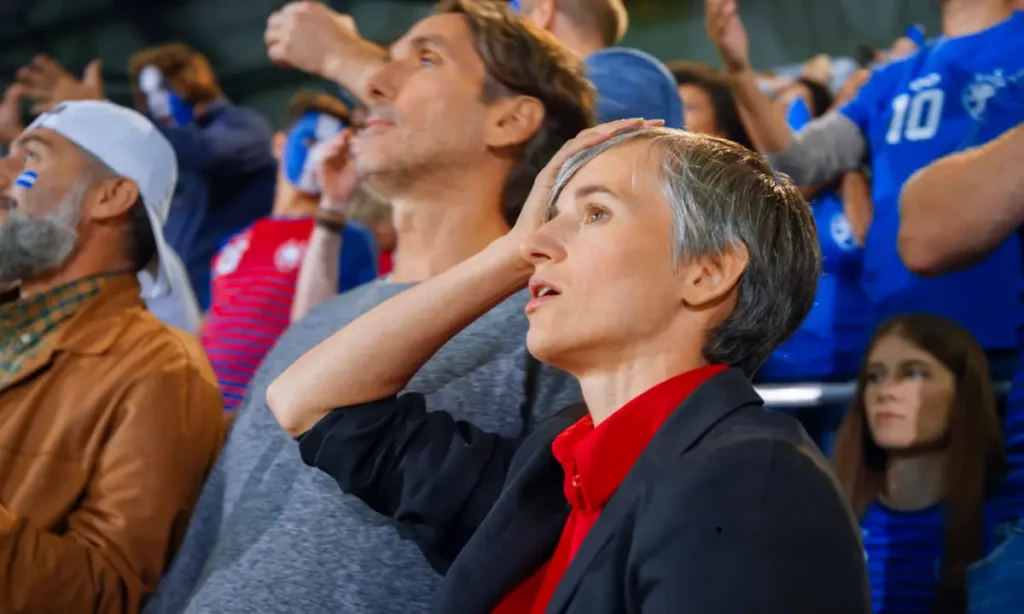
- Passionate Supporters: Fans from both nations show unmatched enthusiasm and loyalty, often turning stadiums and streets into vibrant displays of national pride. Chants, flags, and face paint are common sights as fans rally behind their teams.
- Emotional Highs and Lows: Wins and losses against the arch-rival are celebrated and mourned with extreme fervor. Victories lead to mass celebrations, while losses can spark disappointment or even frustration. Players often face intense pressure, with fans expecting nothing less than victory.
2. Impact of Social Media and Digital Platforms
- Engagement and Memes: Social media platforms like Twitter, Instagram, and YouTube become hotspots of fan engagement, where memes, posts, and match reactions spread rapidly. Hashtags like #IndvPak trend globally, with millions of fans joining the conversation.
- Influencers and Fan Accounts: Cricket influencers, fan accounts, and content creators add to the atmosphere, providing live reactions, match analysis, and humorous commentary that bring fans together across digital spaces.
3. Diaspora Influence and Global Viewership
- Global South Asian Community: The large South Asian diaspora in countries like the United States, United Kingdom, UAE, and Canada adds to the rivalry’s global footprint. This extended fanbase ensures that every match reaches millions of viewers worldwide, with families and friends organizing watch parties.
- Unity Across Borders: Despite the rivalry, there are heartwarming moments of unity and mutual respect between fans. Cricket has the power to bridge cultural divides, creating a shared experience that reflects a complex yet meaningful connection between people of both nations.
4. Media Influence and Broadcast Appeal
- Massive Broadcast Reach: Broadcasters and advertisers are well aware of the rivalry’s commercial potential, and coverage is tailored to maximize viewership. Analysts and former players provide extensive pre- and post-match analysis, adding to the buildup and excitement.
- Narrative Framing: Media in both countries often frame these matches as “clashes of titans,” elevating the rivalry’s importance and sometimes adding to the pressure. This coverage amplifies the emotional stakes for fans and players alike, as each match feels like more than just a game.
5. Symbol of National Identity and Pride
- Beyond Sport: For many fans, an India-Pakistan match symbolizes their national identity, cultural pride, and historical resilience. The rivalry’s intensity is a reminder of shared history, and each victory is seen as a matter of pride on an international stage.
- Generational Legacy: The rivalry is also a cultural inheritance, passed down through generations. Family stories of past games, legendary players, and unforgettable moments keep the rivalry alive, making each encounter a meaningful event for younger fans.
Statistics Section
The statistics between India and Pakistan offer a quantitative view of the rivalry’s balance and intensity across different formats. Here’s a breakdown of head-to-head records, along with some notable achievements by players from both sides.
1. Head-to-Head Summary
Tests
- Total Matches: 59
- India Wins: 9
- Pakistan Wins: 12
- Draws: 38
One Day Internationals (ODIs)
- Total Matches: 139
- India Wins: 57
- Pakistan Wins: 73
- No Results: 9
Twenty20 Internationals (T20Is)
- Total Matches: 13
- India Wins: 9
- Pakistan Wins: 3
- No Results: 1
2. Memorable Records
Top Performances by Players
- Most Runs in ODIs: Sachin Tendulkar (India) and Inzamam-ul-Haq (Pakistan) are among the top run-scorers in ODIs, with contributions that defined their teams’ innings.
- Most Wickets in Tests: Imran Khan (Pakistan) and Anil Kumble (India) have consistently delivered stellar bowling performances in Test matches between the two sides.
Notable Records
- Highest Individual Score in an ODI: Saeed Anwar’s 194 for Pakistan in 1997 remains one of the most memorable batting displays in the rivalry.
- Best Bowling Figures in a Test: Anil Kumble’s 10-wicket haul in 1999 is a record for the highest number of wickets by an Indian bowler in an innings against Pakistan.
Series Wins
- Test Series Wins: Both teams have won four Test series each.
- ODI Series Wins: Pakistan has won 11 ODI series, while India has claimed five, with one series ending in a tie.
3. Highest Scores and Wins by Margin
ODI Highest Team Total
- India: 356 for 2 in the 2023 Asia Cup.
- Pakistan: 344 for 8 in 2004.
Largest Win Margin (Runs) in an ODI
- India: 228 runs in the 2023 Asia Cup.
- Pakistan: 159 runs in 2004.
Here’s a table summarizing the head-to-head statistics:
| Format | Total Matches | India Wins | Pakistan Wins | Draw/No Result |
|---|---|---|---|---|
| Tests | 59 | 9 | 12 | 38 |
| ODIs | 139 | 57 | 73 | 9 |
| T20Is | 13 | 9 | 3 | 1 |
Records
1. Notable Individual Records
Most Runs in ODIs
- India: Sachin Tendulkar has scored the most runs for India in ODIs against Pakistan, amassing over 2,500 runs in his career.
- Pakistan: Inzamam-ul-Haq and Javed Miandad were consistently high scorers in ODIs, with Miandad’s steady performances anchoring many games.
Most Wickets in Tests
- India: Anil Kumble leads India with the highest number of Test wickets taken against Pakistan, including his famous 10-wicket haul in 1999.
- Pakistan: Imran Khan was Pakistan’s leading wicket-taker against India, with his pace and swing creating significant challenges for Indian batsmen.
Highest Individual Score in an ODI
- Pakistan: Saeed Anwar’s 194 in 1997 remains one of the highest ODI scores in the rivalry, standing as a record for over a decade.
- India: Virat Kohli’s 183 in 2012 Asia Cup was a memorable innings that showcased his skill in high-pressure games.
2. Players Who Have Played for Both Teams
- Abdul Hafeez Kardar: Known as the “Father of Pakistani Cricket,” Kardar was one of the few players who represented both India (in pre-partition cricket) and Pakistan (post-partition). His leadership set the foundation for Pakistan’s cricketing journey.
3. Public and Government Reactions to the Rivalry
- Intense Fan Reactions: The rivalry often sparks extreme reactions from fans, with celebrations turning into street parties after victories, and sometimes even harsh criticism or disappointment after losses. Matches are often framed as events of national pride.
- Media Coverage: The rivalry commands massive media coverage, with live commentary, analysis, and fan reactions making each encounter a national event.
4. Cricket Diplomacy Between India and Pakistan
- Efforts for Peace: Cricket diplomacy has been a tool for fostering relations, with heads of state attending matches. Instances like President Zia-ul-Haq’s 1987 visit and Prime Minister Manmohan Singh inviting Pakistan’s Prime Minister Yousuf Raza Gilani to the 2011 World Cup semi-final exemplify how cricket serves as a bridge in diplomacy.
- Impact on Bilateral Relations: Although political tensions have often disrupted scheduled series, the few bilateral matches held have encouraged goodwill between fans and officials, demonstrating cricket’s potential as a unifying force.
See Also
Here are some related topics that provide further insights into the historical and cultural context of the India-Pakistan cricket rivalry:
- India–Pakistan Relations: A broader look at the political, social, and economic relationship between India and Pakistan, including key historical events and diplomatic challenges.
- History of Cricket in India and Pakistan: Articles covering the development of cricket in each country, detailing how both nations became cricketing powerhouses.
- Cricket Diplomacy: An exploration of how cricket has been used as a diplomatic tool to ease tensions between India and Pakistan and promote peaceful relations.
- Asia Cup and ICC Tournaments: A look at regional and international tournaments where India and Pakistan often compete, influencing their rivalry.
- Sachin Tendulkar vs. Shoaib Akhtar: A famous player rivalry within the India-Pakistan context, showcasing memorable face-offs between these two cricketing legends.
- List of Cricket Records and Statistics in India-Pakistan Matches: An overview of significant records and statistics, including individual and team achievements, in various formats.
References
- India–Pakistan Cricket Rivalry – Wikipedia: This article covers the history, key moments, and statistical data on the India-Pakistan cricket rivalry, offering a detailed look at the factors contributing to the intensity of this sporting rivalry.
- India-Pakistan Head-to-Head Records – ESPN Cricinfo: ESPN Cricinfo’s comprehensive records section provides head-to-head statistics and match results, giving readers access to updated records and detailed analysis of matches across different formats.
- International Cricket Council (ICC) and Asian Cricket Council (ACC) official tournament archives for specific match information, tournament records, and player achievements.
- Various historical accounts and match commentaries from ICC tournament archives to provide context for iconic moments like the 1986 Austral-Asia Cup and 2007 T20 World Cup final.



1 thought on “India–Pakistan Cricket Rivalry: An Introduction”