
A starter motor, also known as a cranking motor, is a crucial component in an internal combustion engine system. It is a powerful direct current (DC) motor designed to initiate the engine’s operation by cranking it, thereby providing the necessary torque to turn the crankshaft and start the combustion process.
In this article, we’ll dive deep into the starter motor’s functionality, construction, and its key components, along with its operational mechanism. Understanding how a starter motor works and its role in the engine system is essential for anyone interested in automotive engineering or vehicle maintenance.
What is a Starter Motor?
The starter motor is responsible for turning the engine over, which allows the piston to reciprocate and the engine to begin running. This component is installed in the engine flywheel housing and is typically series-wound, designed to operate at low voltages while drawing a significant amount of current. When the engine is started at low speeds, the starter motor must generate a tremendous amount of torque.
To achieve the necessary torque, thick wire is used in the construction of the armature and field windings to lower electrical resistance and enable the motor to carry large currents without overheating. As the motor’s speed increases, it uses less current and continues to generate higher torque at lower speeds, making it efficient and effective in cranking the engine to life.
Key Components of a Starter Motor
The starter motor is composed of several vital parts that work together to ensure the engine starts properly. Below is a breakdown of these components:
- Armature: The armature is an electromagnet part that guides the drive shaft or bearings. It consists of a laminated soft iron core wrapped with multiple conductors that create an electromagnetic field when current flows through them.
- Commutator: The commutator is a rotating part located at the back of the housing. It comprises two plates mounted on the armature’s axle, connecting the electromagnet’s coil. Brushes run along the commutator, conducting electricity to the armature windings.
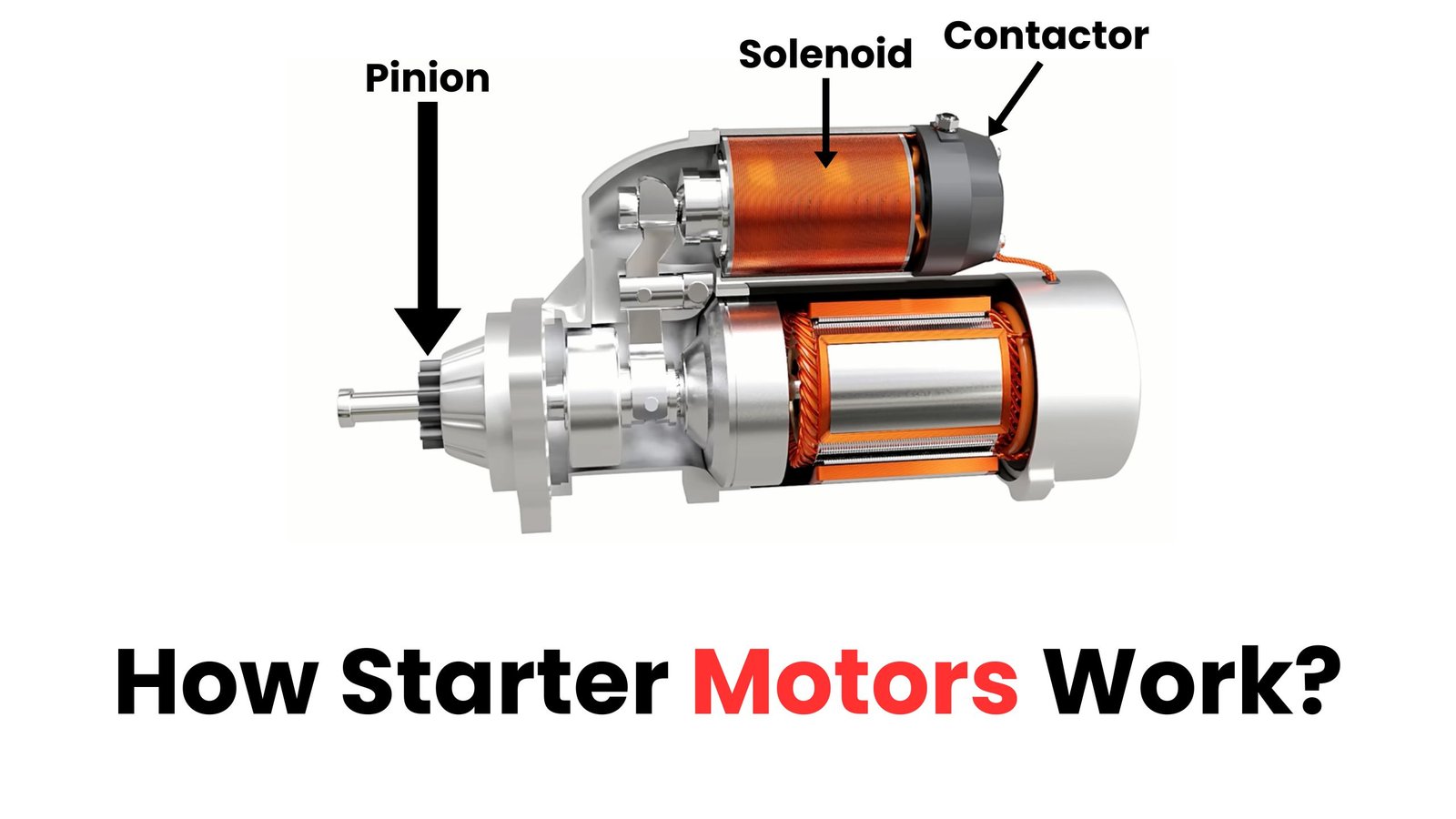
- Solenoid: The solenoid contains two wire coils wrapped around a core and acts as a switch connecting and disconnecting the electrical connection between the starter motor and the vehicle’s battery. The solenoid’s primary function is to engage the starter motor’s pinion gear with the flywheel teeth.
- Brushes: A series of brushes transfer electrical current from a stationary conductor to a rotating one. These brushes maintain contact with the commutator, enabling the flow of electricity to the armature windings.
- Plunger: The plunger in a starter motor pushes forward to engage the pinion gear with the flywheel, initiating the engine start-up.
- Lever Fork: The lever fork is attached to the plunger. When the plunger pushes the lever fork forward, it engages the pinion with the flywheel.
- Pinion: The pinion is a small gear that engages immediately after the engine starts by extending its gear teeth to mesh with the flywheel teeth. It plays a critical role in transmitting torque from the starter motor to the engine’s crankshaft.
- Field Coils: The field coils consist of two or more coils connected in series and are secured in the motor housing by screws. When powered by the battery, these coils become electromagnets that create a magnetic field around the armature, causing it to rotate.
How a Starter Motor Works
When the ignition key is turned, a small current flows into the solenoid coil, which consists of two coils—known as the pulling coil and the holding coil. The end of the holding coil connects to the casing of the starter motor, allowing current to return to the battery through the car frame. The pulling coil connects to the main output terminal, and both coils get energized, creating a strong magnetic field that pulls the piston back. When the contactor plate connects across the main terminals, the voltage difference across the pulling coil is nullified, turning it off. However, the holding coil remains active to keep the piston in position.
As the piston moves back, it pulls on the lever, pivoting and transferring the motion to the drive sleeve, pushing it forward. The slight rotation of the pinion allows it to lock the rollers in the clutch and slide into the flywheel. As the contactor plate connects across the terminals and the pull-in coil is turned off, a large current flows through the contactor plate, through thick wires, and into the brushes. From here, the current travels to the commutator plates, through the armature coil, and then back to another commutator plate and brush, grounded to the car’s frame. This process completes the circuit and allows the current to return to the battery.
The electromagnetic field produced by the armature coil interacts with the permanent magnet or field winding in the stator, causing the rotor (or armature) to rotate rapidly and with high torque. This torque is then transferred through the shaft, clutch, and pinion gear, which in turn rotates the flywheel. As the flywheel begins the combustion process, the engine starts to rotate faster than the starter motor, disengaging the overrunning clutch and allowing the pinion gear to spin freely.
When the ignition key is released, power to the solenoid coil is cut, releasing the piston. The spring pushes the lever back, disengaging the pinion gear from the flywheel. The current to the starter motor is then cut, allowing the combustion engine to continue running independently while the alternator recharges the battery.
The Importance of Solenoid and Contactor in Starter Motors
The solenoid and contactor are critical in a starter motor system because they reduce complexity and handle high current demand more efficiently than a direct connection between the battery and the motor. If the motor were directly connected to the battery, it would require an unusually large ignition switch and very thick wires, which is impractical for most automotive designs.
Instead, the solenoid requires only a small current to get energized and performs two crucial functions. First, it engages the pinion with the flywheel before the motor starts spinning. Second, it connects the circuit from the battery to the motor through the contactor switch, allowing the starter motor to function effectively without the need for overly large components or wiring.
The Role of Planetary Gears in Starter Motors
Starter motors utilize planetary gears to achieve large gear reductions in a compact space. A planetary gear set consists of a sun gear, a ring gear, a carrier, and a set of planet gears.
In this setup, the ring gear is fixed, the sun gear acts as the input, and the planet carrier serves as the output. This configuration provides a significant gear reduction, increasing the torque generated by the starter motor to a level sufficient to crank the engine.
Conclusion
The starter motor is an essential component for starting internal combustion engines. It combines various parts and mechanisms to provide the necessary torque and rotational force to the crankshaft, enabling the engine to start efficiently. Understanding its construction and operation is crucial for diagnosing issues and maintaining optimal performance in automotive systems.