
When talking about motorcycle brakes, the debate between axial and radial brakes often comes up. Both types are made to stop your bike effectively, but they have different designs and performances that can be important, especially for those who ride hard. Knowing the difference between axial and radial brakes isn’t just about figuring out which one is “better”—it’s about finding out which one is better for your specific riding style.
Axial brakes are mounted at a right angle to the bike and are commonly found on regular motorcycles. They’re dependable, affordable, and work well for everyday riding. Radial brakes, mounted parallel to the bike, are used on high-performance and racing motorcycles. They provide better precision, feedback, and control, making them popular among riders who need very accurate braking.
But is the difference between these two systems really that important for the everyday rider? And what about the common misunderstandings about radial master cylinders and braking power? In this article, we’ll explore the differences between axial and radial motorcycle brakes, break down the technical details, clear up some myths, and help you decide which brake system is better for your bike.
What Are Axial and Radial Brakes?
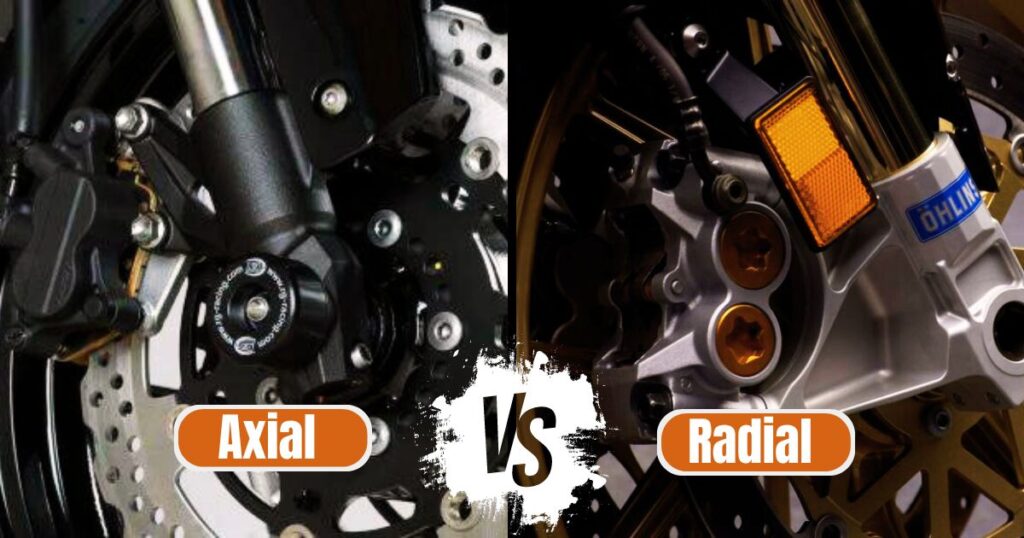
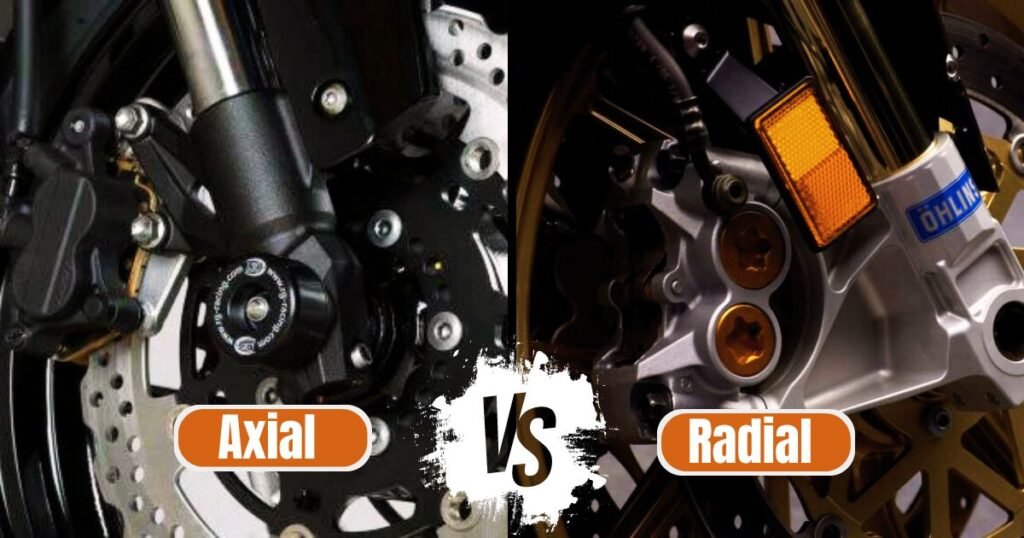
When it comes to hydraulic disc brake calipers, the terms “axial” and “radial” refer to how the brake caliper is mounted to the fork leg of the motorcycle.
- Axial Brakes: In axial brake systems, the calipers are mounted with bolts running perpendicular to the bike. These are commonly found on many standard motorcycles and are often considered the traditional setup.
- Radial Brakes: Radial brake calipers, on the other hand, are mounted with bolts running parallel to the bike. This setup is more common on high-performance and racing bikes, where precise braking is crucial.
Advantages and Disadvantages of Axial and Radial Brakes
Here’s a comparison of the advantages and disadvantages of axial and radial brakes:
Here’s the table you requested:
| Aspect | Axial Brakes | Radial Brakes |
|---|---|---|
| Mounting | Perpendicular to the bike | Parallel to the bike |
| Common Usage | Standard motorcycles, motocross bikes | High-performance, racing, and sport motorcycles |
| Alignment with Brake Disc | More play and flex, potential for misalignment | Better alignment with the brake disc, reduced brake rub, and increased stiffness |
| Ease of Maintenance | Easier to maintain for regular use | Slightly more complex due to the precision needed |
| Performance | Adequate for everyday riding, can handle 95% of street riding needs | Superior feel, feedback, and modulation, especially at high speeds and severe braking |
| Cost | Typically less expensive, found on more affordable bikes | More expensive due to higher quality materials and development costs |
| Appearance | Less flashy, more utilitarian | Generally considered more aesthetically pleasing and performance-oriented |
Radial Master Cylinders and Braking Power
Many motorcycle enthusiasts mistakenly believe that radial master cylinders make braking stronger. This isn’t exactly true. The strength of the braking force mostly depends on the brake fluid pressure, not the type of master cylinder.
Radial master cylinders are often praised for giving a better “feel” and “feedback” while braking. However, this doesn’t mean they make the brakes stronger. Instead, they allow for more precise control of the braking force, which can be very important in high-performance situations.
How Does the Design of Master Cylinders Change the Feel?
The design of the master cylinder, whether axial or radial, influences how force is transmitted from the brake lever to the brake caliper. In an axial master cylinder, the piston runs parallel to the handlebars. This means the force applied to the brake lever is at a 90-degree angle to the force that ultimately presses the brake pads against the rotor.
In contrast, a radial master cylinder has a piston that runs perpendicular to the handlebars. This setup allows the force from the brake lever to be applied more directly, improving the rider’s ability to modulate braking pressure.
From a physics perspective, the difference in feel can be attributed to the direction and efficiency of force application. Radial master cylinders are often preferred because they allow for a more linear and direct application of force, which translates to better control and feedback. However, this doesn’t mean they increase the actual braking power; they just make it easier for the rider to control that power.
The Physics Behind Rotor Placement: It’s Not Just About the Caliper
Another aspect often overlooked in the axial vs. radial debate is the role of rotor placement. Some riders believe that the way a caliper is mounted (axial vs. radial) determines its braking effectiveness. However, it’s essential to consider where the rotor is mounted as well.
The distance of the rotor from the axle can significantly impact braking performance. Rotors closer to the axle make the caliper work harder to stop the bike because the braking force must overcome a greater mechanical advantage. Conversely, rotors placed farther from the axle reduce the amount of force needed by the caliper to achieve the same braking effect.
This is why some motorcycles, like the Buell, can perform exceptionally well with an axial brake setup. In these cases, the superior performance isn’t necessarily due to the type of caliper but rather the strategic placement of the rotor, which maximizes braking efficiency.
Real-World Application: Does It Really Matter?
For most riders, especially those who mainly ride on the street, the differences between axial and radial brakes might not be noticeable. Axial brakes are more than good enough for everyday riding and are usually cheaper. However, for those who push their bikes to the limit, like in racing or high-speed riding, the extra feedback and precision from radial brakes can make a difference.
It’s also important to know that radial brakes are often linked with high performance, so many manufacturers include them on higher-end models, even if the benefits might be small for regular riding. The better materials and research used in radial systems usually result in higher-quality parts, making them a popular choice for those wanting to upgrade their brakes.
Also Read About- Motorcycle Maintenance
Conclusion: Axial vs. Radial—Which is Better?
In Conclusion, both axial and radial brakes are important in the motorcycle. Axial brakes provide good performance for most riders and are usually cheaper. Radial brakes, which are often seen as better in terms of feel and control, are especially useful in high-performance situations where precise braking is important.
In the end, choosing between axial and radial brakes depends on what you need as a rider. Whether you’re riding daily or racing at high speeds, knowing the differences between these brakes will help you make the right choice for your style and needs.